
Author Guidelines
Journal of Indian and International Knowledge System (JIIKS) is an open-access, double-anonymized peer-reviewed journal for Original Articles (Full Papers), Communications, Perspectives, Reviews, Editorials, Historical Notes, News and Events, Policy Analysis, Book Reviews, Conference Proceedings (Special Issue), Activities and Demonstrations on Indian and International Knowledge System and Traditions.
Please read the following guidelines before submitting. Manuscripts that do not follow them are returned to the authors before review.
Contents
1. Journal at a glance
2. Scope and article types
3. Before you submit
4. Manuscript preparation
5. Transliteration, scripts and primary texts
6. References
7. Tables, figures and images
8. Research and publication ethics
9. Authorship, disclosures and data
10. Peer review and editorial process
11. Open access, license and fees
12. After acceptance
13. Submission checklist
1. Journal Details
Item | Detail |
Full Title | Journal of Indian and International Knowledge System |
Abbreviation | J. Indian Int. Knowl. Syst. |
Official Journal of | YSB Foundation, Public Charitable Trust, Uttarakhand, India |
Publisher | REVO Publication Pvt. Ltd., New Delhi, India |
Editor-in-Chief | Dr. Chinnappan Baskar, President, YSB Foundation |
Access Model | Gold open access; free to read on publication |
Article Processing Charge (APC) | None for the first two years of publication |
License | Creative Commons Attribution 4.0 International (CC BY 4.0) |
Copyright Retention | Authors retain the copyright to their work |
Peer Review | Double-anonymized; at least two independent reviewers for research and review papers |
Language | US English (primary-source quotations in original scripts welcome) |
Frequency | Monthly |
ISSN (Online) | |
DOI | |
Submission | |
Editorial Contact | |
Website |
2. Scope and article types
Subject areas
JIIKS welcomes scholarly contributions in, but not limited to, the following areas:
• Indian Knowledge Systems (IKS)
• Philosophy; Indian and comparative philosophy (darśana)
• History, Heritage, and Cultural Studies
• Vedic, Sanskrit, Pāli, Prakrit, Tamil and other classical literatures
• Education 1.0 to Education 5.0; Pedagogical Traditions and Teaching Methodology on Indian Knowledge Systems (IKS) and International Knowledge Systems
• IKS in Modern Education and Research
• Indigenous and Traditional Knowledge Systems
• Social Sciences and Humanities on Indian Knowledge Systems (IKS) and International Knowledge Systems
• Training/Orientation of Faculty; Courses and Modular Curriculum Framework and Teaching in Higher Education on Indian Knowledge System as per the guidelines of University Grants Commission (UGC); National Education Policy 2020 (NEP 2020); National Credit Framework (NCrF)
• Ayurveda, Yoga, and Traditional Health Practices, discoveries and Sustainable Development
• Vedic Science and Holistic Living
• History of Science, Engineering, Technology, and Mathematics in Historical and Contemporary Contexts
• Environmental Studies and Sustainability
• Literature, Languages, and Linguistics
• Ethics, Human Values, and Spiritual Studies
• International and Comparative Knowledge Systems
• Interdisciplinary and Multidisciplinary Research
Out of scope. Submissions must engage critically with a knowledge tradition, not only describe or praise it. JIIKS does not publish devotional or promotional writing without scholarly argument, clinical claims for traditional remedies without evidence, or papers that use IKS only as a label for unrelated work.
Article types
JIIKS publishes the article types below. Choose the one that fits before you write, because structure and peer review differ. There is no fixed limit on the length or number of pages of a manuscript, or on the length of its title; write as concisely as the argument allows.
Article type | What it is | Abstract | Peer review |
Original Article (Full Paper) | New research based on textual, historical, philosophical, empirical or field-based study, with a clear method or argument. Includes critical editions and annotated translations of primary texts, and field studies of living traditions | Structured, 200–250 words | Double-anonymized |
Communication | A focused new finding, source discovery or method note | Unstructured, 200–250 words | Double-anonymized |
Perspective | Reasoned position on a debate, approach or method in a knowledge tradition | Unstructured, 200–250 words | Editorial + one external reviewer |
Review | Systematic, scoping or critical review of a defined body of literature | Structured, 200–250 words | Double-anonymized |
Editorial | Written or invited by the editors (not open for unsolicited submission) | None | Editorial review |
Historical Note | Short, source-based account of a person, text, institution, instrument or discovery in the history of a knowledge tradition | Unstructured, 200–250 words | Editorial + one external reviewer |
News and Events | Reports and announcements of conferences, workshops, seminars, awards and other events relevant to knowledge systems | None | Editorial review |
Policy Analysis | Evidence-based analysis of a policy or framework on knowledge systems, e.g. NEP 2020, UGC guidelines on IKS or the National Credit Framework (NCrF) | Unstructured, 200–250 words | Double-anonymized |
Book Review | Critical review of a scholarly book published in the last three years | None | Editorial review |
Conference Proceedings (Special Issue) | Selected papers from a conference, published as a special issue agreed in advance with the Editor-in-Chief | As for the article type of each paper | Double-anonymized |
Activities | Reports of institutional activities such as IKS centers, faculty training and orientation programs, courses and curriculum initiatives | None | Editorial review |
Demonstrations | Documented demonstration of a traditional technique, practice, instrument, experiment or teaching method, supported by images or video | Unstructured, 200–250 words | Editorial + one external reviewer |
Reviews from authors with no prior publication on the topic need a pre-submission inquiry: send a 300-word outline to the editorial office first. Editorials are commissioned and are not open for unsolicited submission. Proposals for a Conference Proceedings special issue go to the Editor-in-Chief before any papers are submitted; each paper is then reviewed according to its article type.
3. Before you submit
Submit only work that is original, complete and not under review anywhere else. Every manuscript is screened for these points before an editor reads it.
• Originality. The manuscript must not be published or under consideration elsewhere, in any language. A translated version of your own published paper is duplicate publication unless the editor agrees in advance and the original is cited.
• Preprints. Posting a preprint on a recognized non-commercial server (for example SSRN, Zenodo, OSF Preprints or an institutional repository) is allowed. Declare it in the cover letter and add its DOI; after publication, link the preprint to the JIIKS version of record.
• Theses and conference papers. An article derived from a PhD thesis (including one deposited in Shodhganga) or a conference presentation is welcome if it is substantially rewritten for a journal audience. Declare the source in the cover letter.
• Similarity check. All submissions are checked with similarity-detection software. Overall similarity above 15%, or above 3% from any single source, is returned to the author before review. Correctly cited primary-text quotations (verses, sūtras, archival passages) and the reference list are excluded from this count.
• Language. Write in clear academic English, using US (American) spelling consistently. Explain specialist terms from any tradition at first use so that readers from other disciplines can follow.
• Scope fit. Read the aims and scope and at least two recently published JIIKS articles. Submissions outside scope are declined at desk review, usually within 7 days.
• Active submissions. An author may have no more than two manuscripts under review at the same time, and no more than one as corresponding author.
4. Manuscript preparation
Upload two separate files: a title page with all author details, and an anonymized main manuscript with no names, affiliations or self-identifying references.
Files to upload
1. Cover letter - why the paper fits JIIKS, its main contribution in two or three sentences, and any declarations (preprint, thesis origin, related papers).
2. Title page - see contents below.
3. Anonymized main manuscript (.docx; LaTeX) - title, abstract, keywords, main text, references, tables and figure captions.
4. Figures - separate high-resolution files (see Section 7).
5. Supplementary files - original-script texts, data, questionnaires, blank consent forms, audio or video.
6. Declarations form - authorship, conflicts, ethics, funding and AI use, signed by the corresponding author on behalf of all authors.
Title page contents
• Article type and full title (avoid unexplained abbreviations)
• Running title (≤ 60 characters including spaces)
• Full names of all authors, in the form they wish to be published, with ORCID IDs
• Affiliation for each author: department, institution, city, country
• Corresponding author: postal address, institutional email and phone
• Word count of main text, and number of tables and figures
• Acknowledgments, funding, conflict-of-interest and author-contribution statements (kept out of the anonymized file)
Anonymizing the manuscript
Remove names from the file properties (in Word: File → Info → Inspect Document). Cite your own earlier work in the third person, for example “Sharma (2023) argued”, not “as I argued (Sharma, 2023)”. Replace identifying details of your institution or field site with “[Institution]” where they would reveal you; restore them at acceptance.
Abstract and keywords
Original Articles and Reviews use a structured abstract of 200–250 words with the headings Background, Objectives, Methods (or Sources and Approach), Findings and Conclusion. Other article types that carry an abstract (see Section 2) use a single paragraph of 200–250 words. Do not cite references in the abstract. Give 5–7 keywords that are not already in the title; transliterated terms are welcome as keywords if an English equivalent is also given (for example, ṛta; cosmic order).
Structure of the main text
• Empirical, field or survey-based papers: Introduction; Literature Review; Methods (setting, participants or sources, data collection, analysis, ethics approval); Results; Discussion (including limitations); Conclusion.
• Textual, philosophical and historical papers: Introduction (research question and argument); Sources and Approach (texts, editions, manuscripts and interpretive method used); thematic sections with informative headings; Conclusion stating what the paper adds to existing scholarship.
• Reviews: state the search strategy, databases and repositories searched, date range, inclusion criteria and how sources were appraised. Systematic reviews should follow PRISMA 2020.
• End every article with a Declarations section (see Section 9) and the References list.
Formatting
Element | Requirement |
Page | A4, 2.5 cm margins on all sides |
Font | A Unicode font that displays diacritics and Indic scripts correctly (for example Noto Serif, Gentium Plus or Times New Roman), 12 pt for text, 10 pt for notes |
Spacing | 1.5 lines; one blank line between paragraphs, no first-line indent |
Headings | Up to three levels, numbered (1, 1.1, 1.1.1), sentence case |
Numbers | Line numbers and page numbers switched on |
Notes | Footnotes only for explanatory remarks, kept brief; never for references |
Quotations | In double quotation marks; quotations over 40 words as an indented block without quotation marks |
Emphasis | Italics for emphasis and for non-English words; no underlining or bold in running text |
Dates | Give Common Era dates; indigenous eras (Vikrama Saṃvat, Śaka) may follow in brackets, e.g. 1650 CE (VS 1707) |
Units | SI units; traditional units (e.g. tolā, yojana) with an SI equivalent at first use |
5. Transliteration, scripts and primary texts
Use an established international transliteration scheme with full diacritics, applied consistently. JIIKS does not accept author-invented or simplified schemes in the final text. Write Vāgbhaṭa, Śaṅkara and Kṛṣṇa, not Vagbhat, Shankara and Krishna.
Schemes by language
Language or script | Scheme | Example |
Sanskrit, Pāli, Prakrit, Apabhraṃśa | IAST | Bṛhadāraṇyaka Upaniṣad, pratītyasamutpāda |
Hindi, Marathi, Bengali, Gujarati, Punjabi, Odia, Assamese, Nepali | ISO 15919 or ALA-LC (choose one) | Rāmcaritmānas, Jñāneśvarī |
Tamil, Telugu, Kannada, Malayalam | ISO 15919 | Tirukkuṟaḷ, Tolkāppiyam |
Persian, Arabic, Urdu | IJMES or ALA-LC | Āʾīn-i Akbarī |
Tibetan | Extended Wylie | bstan 'gyur |
Chinese | Hanyu Pinyin with tone marks where relevant | Dà Táng Xīyù jì |
Harvard-Kyoto, ITRANS and Velthuis are for typing only; convert them before submission. Use Unicode characters, not legacy fonts such as Kruti Dev, Shree Lipi or Bamini, which do not survive conversion to XML.
Terms, names and places
• Italicize transliterated terms and give an English gloss at first use: pramāṇa (means of valid knowledge). Thereafter use the term alone.
• Words in standard English dictionaries (karma, yoga, guru, mantra, ashram) stay in roman type without diacritics unless used in a technical sense, where the italic form with diacritics applies: karman in Mīmāṃsā ritual theory.
• Form plurals with a roman “s”: sūtras, śāstras.
• Classical and pre-modern names take diacritics: Pāṇini, Āryabhaṭa, Kauṭilya, Tiruvaḷḷuvar.
• Modern persons and modern place names keep their customary English spelling without diacritics: Rabindranath Tagore, Swami Vivekananda, Varanasi, Thanjavur. Historical place names in historical context may take diacritics: Kāśī, Pāṭaliputra.
• Titles of texts are italicized with diacritics: Arthaśāstra, Nāṭyaśāstra, Caraka Saṃhitā.
Quoting in original scripts
Key passages may be quoted in Devanāgarī or another original script, followed by the IAST transliteration and an English translation. Keep original-script quotation to what the argument needs; longer source texts belong in a supplementary file. Supply text as Unicode, never as an image of text.
Translations
Every non-English quotation needs an English translation. State whether each translation is your own (“translation mine” at first use, or a note stating that all translations are the author’s) or taken from a published translation, which must then be cited.
Citing primary texts
Cite classical texts by title and canonical division (book, chapter, verse or sūtra), followed by the page number in the edition you used:
• Bhagavadgītā, chapter 2, verse 47, Page No.
• Ṛgveda, maṇḍala 10, hymn 129, verse 1, Page No.
• Kauṭilīya Arthaśāstra, book 1, chapter 2, sūtra 11, Page No.
• Caraka Saṃhitā, Sūtrasthāna, chapter 1, verse 41, Page No.
Name the edition you used, for example the Bhandarkar Oriental Research Institute critical edition of the Mahābhārata, and list it in the References; the superscript number in the text points to that entry. Add a list of abbreviations before the References if you abbreviate the titles of three or more texts.
Manuscripts and archival sources
Give the repository, collection, shelf mark or accession number, and folio (with r/v or a/b for recto and verso), for example: Repository name, City, MS no. 1234, f. 12v. Cite the published catalog entry where one exists. Confirm in the cover letter that you have the repository’s permission to reproduce any manuscript image.
6. References
Please use numbered citations (inline superscript) within the text, with references numbered in the order of their citation. Each numbered reference should contain only one literature citation, and not multiple sub-parts (a, b, c…). Please use a consistent reference style throughout the manuscript and include:
• Author(s) Name(s)
• Article Title / Chapter Title
• Journal Title / Book Title
• Publisher (for books and proceedings)
• Year of Publication
• Volume & Issue / Book Chapter
• Page Number
• DOI
Every in-text citation must appear in the reference list, and every listed item must be cited. The format follows the American Chemical Society (ACS) style, which reference managers such as Zotero, Mendeley and EndNote provide ready-made.
Examples are given below:
References
Journal Articles
1. Zhang, X.; Li, C.; Chinnappan, A.; Zheng, S.; Sun, Z.; Baskar, C.; Ramakrishna, S. MOFs for handling latent load in air cooling: From moisture adsorption and optimization to application as heat exchanger coatings in air conditioners. Coordination Chemistry Reviews 2023, 495, 215384. https://doi.org/10.1016/j.ccr.2023.215384
2. Jayathilaka, W. A. D. M.; Qi, K.; Qin, Y.; Chinnappan, A.; Serrano-García, W.; Baskar, C.; Wang, H.; He, J.; Cui, S.; Thomas, S. W.; Ramakrishna, S. Significance of Nanomaterials in Wearables: A Review on Wearable Actuators and Sensors. Advanced Materials 2019, 31 (7), 1805921. https://doi.org/10.1002/adma.201805921
Book Chapters
3. Singh, A.; Baskar, S.; Baskar, C. Ionic liquids: Alternative of Conventional Molecular Solvents for Organic Reactions. In Ionic Liquids, Nanofluids and Nanotechnology; Lecture Notes in Nanoscale Science and Technology, Vol. 42; Springer: Cham, 2026; pp 109–131. https://doi.org/10.1007/978-3-032-04008-4_5
Conference Proceedings / Papers
4. Chinnappan, A.; Baskar, S.; Baskar, C. Conversion of Sugars into 5-HMF. In Proceedings of the 3rd International Seminar of Basic Sciences; Pattimura University: Ambon, Indonesia, 2017; pp 5–10. ISBN 978-602-61644-0-7.
Preprints
5. Sihasale, G. T.; Palimbu, S. M.; Lilihata, E. J.; Elim, H. Z.; Baskar, C. Sensitive Portable Measurement and Theoretical Model of Energy Transfer due to Interaction between Optical and Vibrational Observation in Single Vibration: Trinity Light-Sound-Matter Coupling. SSRN 2026, posted June 17, 2026. https://doi.org/10.2139/ssrn.6950566
Other Sources (books, classical texts, policy documents, theses, manuscripts)
6. Olivelle, P. King, Governance, and Law in Ancient India: Kauṭilya’s Arthaśāstra; Oxford University Press: New York, 2013.
7. Easwaran, E., Translator. The Bhagavad Gita, 2nd ed.; Nilgiri Press: Tomales, CA, 2007.
8. Ministry of Education, Government of India. National Education Policy 2020; New Delhi, 2020. https://www.education.gov.in/sites/upload_files/mhrd/files/NEP_Final_English_0.pdf
9. Author, A. B. Title of the Thesis. Ph.D. Thesis, Name of University, City, Year. Shodhganga. http://hdl.handle.net/10603/xxxxxx
10. Title of the Work as Given in the Catalog. Manuscript, MS no. 1234, folios 1–25; Collection Name, Repository Name: City, Country.
The last two entries are templates: replace the placeholder details with those of your own source.
General rules
• Number references consecutively in the order in which they are first cited in the text, and list them in that numerical order. A source cited again keeps its first number.
• Place the superscript number immediately after the word, phrase or punctuation it supports. For several sources, separate the numbers with commas or give a range (2,5 or 4–7).
• Give a DOI as a full link (https://doi.org/…) wherever one exists. Use a URL only when there is no DOI.
• List all authors in each reference entry. When naming authors in the text, use “et al.” for three or more authors, followed by the citation number.
• Titles not in English keep the original title (transliterated) followed by an English translation in square brackets.
• Cite peer-reviewed and scholarly sources wherever possible. Wikipedia, blogs, unverified websites and AI-generated text are not acceptable as sources of fact.
• Self-citation should stay below 15% of the reference list and be relevant to the argument.
• Cite classical and religious texts by canonical division and the page number of the edition used (Section 5), and list that edition in the References.
In-text citation examples
Situation | Example |
One source | …as earlier studies have shown.1 |
Naming the author | Olivelle2 argues that… |
Direct quotation with page | “quoted words”2 (p. 64) |
Two authors | Mishra and Rao3 show that… |
Three or more authors | Nair et al.4 report that… |
Several sources | …in several studies.1,3,5 or a range: …4–7 |
Classical text | Bhagavadgītā, chapter 2, verse 475 (5 = the edition listed in the References) |
Manuscript | Repository name, MS no. 1234, f. 12v6 |
Same source cited again | Reuse its first number: …as noted above.2 |
7. Tables, figures and images
There is no fixed limit on the number of tables and figures, but each must be cited in the text and be understandable on its own.
Tables
• Build tables with Word’s table tool, never as images or tab-spaced text, so they can be converted to XML.
• Number them consecutively (Table 1, Table 2) with a short title above and notes, abbreviations and source below.
• Do not repeat the same data in a table and a figure.
Figures
Figure type | Format | Minimum resolution |
Photographs, manuscript folios, artifacts | TIFF, PNG or high-quality JPEG | 300 dpi at final size |
Line drawings, diagrams, yantra or architectural plans | Vector (SVG, EPS or PDF) preferred; otherwise TIFF or PNG | 600 dpi |
Charts and graphs | Vector or the original Excel/source file | 600 dpi if raster |
Place a caption list after the References and mark the preferred position in the text (“Figure 2 about here”). Supply each figure as a separate file named Figure1, Figure2 and so on. Add one or two sentences of alt text per figure describing its content for readers using screen readers.
Maps
Maps showing India’s external boundaries must follow the boundaries published by the Survey of India. Give a scale, a north arrow and the source of base data.
Permissions and sensitive images
• Obtain written permission to reproduce any figure, photograph, manuscript image or museum object owned by someone else, and state the credit line in the caption (“Reproduced by permission of …”). Permission must cover open-access publication under CC BY 4.0, or the item must be marked as excluded from the license.
• Photographs of identifiable people, healers, ritual specialists or community practices need the consent of the people shown and, where relevant, of the community authority (for example the gram sabha or community head).
• Do not publish images that a community regards as secret, sacred or restricted. If unsure, ask the community and tell the editor.
• Minor edits to brightness or contrast are acceptable if applied to the whole image. Do not add, remove or move any feature of an image of a manuscript, inscription or artifact.
8. Research and publication ethics
JIIKS follows the Core Practices and flowcharts of the Committee on Publication Ethics (COPE) for every submission, review and post-publication concern. Breaches lead to rejection, or to correction or retraction after publication.
Misconduct
JIIKS treats the following as misconduct: fabrication or falsification of data or sources; plagiarism, including translating another scholar’s work without credit and reusing your own published text without citation; duplicate or redundant publication; citation manipulation; undisclosed paper-mill or ghost-written content; and altering images of manuscripts, inscriptions or artifacts. Suspected cases are investigated, the author is given a chance to respond, and cases may be reported to the author’s institution.
Scholarly standards for claims about tradition
Claims about historical scientific, medical or technological achievements must rest on dated primary sources, critical editions, archaeological evidence or experimental data, cited precisely. Reading modern scientific findings back into ancient texts without textual and historical support will be returned for revision. Critical engagement with any tradition is welcome; writing that demeans a religion, caste, community, region or gender is not.
Research with human participants
• Fieldwork, interviews, surveys, focus groups and clinical studies need approval from an Institutional Ethics Committee (IEC) or equivalent. Give the committee’s name and approval number in the Methods section.
• Health research conducted in India should follow the ICMR National Ethical Guidelines for Biomedical and Health Research Involving Human Participants (2017).
• Obtain informed consent from every participant. For participants who do not read or write, recorded oral consent witnessed by an independent person is acceptable; describe the procedure.
• Protect identity with pseudonyms unless participants have explicitly asked to be named and have consented to publication of identifying details or images.
• Purely textual, archival or philosophical research does not need ethics approval. If you had no access to an ethics committee for fieldwork, explain in the cover letter how you met these standards; the editor will decide whether the work can proceed to review.
Traditional knowledge, communities and biological resources
• Prior informed consent. Documentation of traditional or community knowledge requires the prior informed consent of the knowledge holders and, where relevant, of the community authority. Keep a copy of the consent record and provide it to the editor on request.
• Credit. Acknowledge knowledge providers by name or by community, as they prefer. Where a knowledge holder contributed substantially to the work, consider co-authorship.
• Sharing back. Share your findings with the knowledge-providing community, in a language they use, and state in the paper how you did so.
• Unpublished knowledge. If a practice, formulation or technique has not been recorded before, tell the community what publication in an open-access journal will mean before you submit. Do not publish knowledge a community wishes to keep restricted.
• Indian law. Research that accesses biological resources or associated traditional knowledge from India must comply with the Biological Diversity Act, 2002 (as amended in 2023). Publication of research papers is exempt from prior approval when it follows Central Government guidelines, but transferring research results to foreign entities or applying for intellectual property rights requires approval from the National Biodiversity Authority. Compliance is the author’s responsibility.
• International work. Research using resources from other countries must comply with that country’s access and benefit-sharing law and the Nagoya Protocol.
• Indigenous data. Manage data from Indigenous and local communities according to the CARE Principles for Indigenous Data Governance (Collective benefit, Authority to control, Responsibility, Ethics).
Ayurveda, Yoga and other health studies
• Register clinical trials in the Clinical Trials Registry – India (CTRI) or another WHO-recognized registry before enrolling the first participant, and give the registration number in the abstract.
• Follow the relevant reporting guideline: CONSORT (with its herbal-intervention extension) for trials, CARE for case reports, ARRIVE for animal studies, STROBE for observational studies and PRISMA 2020 for systematic reviews.
• Identify plant material by accepted botanical name with author, as listed in Plants of the World Online or World Flora Online, together with the vernacular and Sanskrit name and a herbarium voucher number.
• Describe the source, authentication and quality control of every formulation tested.
• Do not present a traditional remedy as a treatment for any disease unless the study design supports that claim.
Use of generative AI
JIIKS follows the COPE position on authorship and AI tools.
• AI tools cannot be listed as authors, because they cannot take responsibility for the work.
• Disclose any use of generative AI in writing, translation, data analysis or image production in a statement titled “Declaration of generative AI use”, placed before the References. Name the tool and version and say what it was used for. Basic spelling and grammar checkers need no declaration.
• You are fully responsible for everything in the manuscript, including text, translations and references produced with AI help. Check every reference against the original source; fabricated references lead to rejection.
• Do not use AI to create or alter images of manuscripts, inscriptions, artifacts or field sites.
• Machine translation of primary texts must be declared and checked against the original by the author.
• Reviewers and editors must not upload submitted manuscripts to AI tools, because this breaks confidentiality.
9. Authorship, disclosures and data
Every listed author must have made a substantial intellectual contribution and must approve the final version. A Declarations section at the end of the manuscript records who did what, who paid for it and where the data are.
Who qualifies as an author
An author must meet all four conditions: a substantial contribution to the conception, sources, data or interpretation; drafting or critically revising the text; approving the version to be published; and agreeing to be accountable for the whole work. Supervising a thesis, providing funding or heading a department does not by itself qualify. List other contributors, translators, informants and institutions in the Acknowledgments.
ORCID and author details
The corresponding author must supply an ORCID ID; all co-authors are strongly encouraged to do so. The ORCID ID is registered with the article’s DOI metadata.
Changes to authorship
Adding, removing or reordering authors after submission requires a written request from the corresponding author with the reason and the signed agreement of every author, including anyone removed. No changes are made after acceptance except to correct an error.
Editors as authors
Members of the JIIKS editorial team may submit, but the manuscript is handled by another editor and goes through the same double-anonymized review. The author takes no part in any decision on it and must declare the editorial role at submission. The journal keeps papers by its own editors to a small share of each issue.
Declarations section (end of manuscript)
Include each of these headings, writing “Not applicable” where needed:
1. Author contributions - using CRediT roles, for example: “A.S.: Conceptualization, Investigation, Writing – original draft. R.I.: Methodology, Translation of primary sources, Writing – review and editing.”
2. Funding - funder name and grant number, or “This research received no specific grant from any funding agency.”
3. Conflict of interest - any financial, institutional, personal or religious-organizational interest that could be seen to influence the work, or “The authors declare no conflict of interest.”
4. Ethics approval and consent - committee name and approval number; how consent and prior informed consent were obtained.
5. Data availability - where the data, transcripts, recordings or editions can be found (see below).
6. Declaration of generative AI use - tool, version and purpose, or “No generative AI was used.”
7. Acknowledgments - people, communities, libraries, archives and manuscript repositories that helped.
In the anonymized manuscript, keep items 1, 2, 3 and 7 on the title page only.
Data availability
Deposit data that support your findings, such as survey data, transcriptions, digitized manuscripts you are permitted to share, or code, in a recognized repository (for example Zenodo, OSF or an institutional repository) and cite it with its DOI. Community-held knowledge may be restricted at the community’s request; in that case state the restriction and how a bona fide researcher can request access.
10. Peer review and editorial process
JIIKS uses double-anonymized peer review: authors and reviewers do not learn each other’s identities. Every research or review paper that passes desk review is read by at least two independent experts; other article types are reviewed as shown in Section 2. The target time from submission to first decision is 8 weeks.
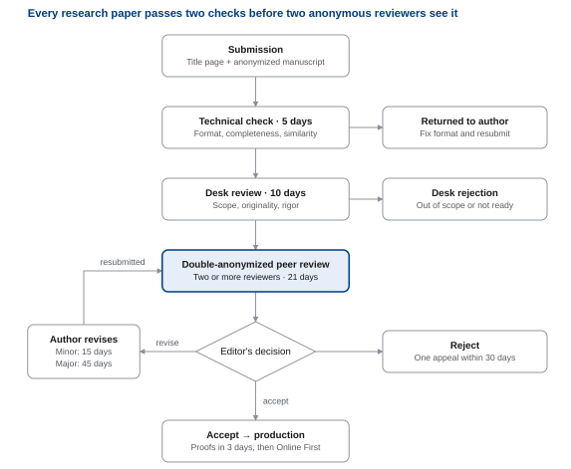
Figure 1. The JIIKS editorial process
A paper that fails the technical check comes back for fixing, not rejection. A revised paper returns to the same reviewers wherever possible.
Stages and target times
Stage | Handled by | Target time |
Technical check | Editorial office | 5 working days |
Desk review | Editor-in-Chief or section editor | 10 days |
Peer review | At least two external reviewers | 21 days per round, one 14-day extension |
First decision | Handling editor | 8 weeks from submission |
Minor revision | Author | 15 days |
Major revision | Author | 45 days |
Proof correction | Corresponding author | 3 working days |
How reviewers are chosen
• Reviewers hold a doctorate or equivalent expertise and have published in the paper’s subject. For textual and translation papers, at least one reviewer reads the source language.
• Reviewers never come from the author’s institution; at least one comes from outside the author’s country wherever the field allows.
• Reviewers declare any conflict, such as collaboration with or supervision of an author in the past three years, and step aside if one exists.
• Authors may suggest up to three reviewers with no conflict of interest, and ask that up to two named people be excluded. The editor is not bound by either.
Decisions and revisions
• The editor decides Accept, Minor revision, Major revision or Reject, based on the reviews and the editor’s own reading. Where reviewers disagree, the editor consults a third reviewer or decides with reasons.
• Submit a revision with a point-by-point response to every comment and a tracked-changes version of the manuscript. If you disagree with a reviewer, explain why.
• A revision not returned within the deadline is treated as withdrawn unless an extension has been agreed.
• Reviewers’ reports, with identities removed, are sent to the author with every decision.
Confidentiality
Manuscripts under review are confidential. Editors and reviewers may not share them, use their content in their own work, or upload them to AI tools.
11. Open access, license and fees
Every JIIKS article is free to read and reuse from the day it is published, under a CC BY 4.0 license, and the authors keep their copyright.
License and copyright
• Articles are published under the Creative Commons Attribution 4.0 International license (CC BY 4.0). Anyone may share and adapt the work for any purpose, provided the authors and the original JIIKS publication are credited.
• Authors retain copyright and grant REVO Publication a non-exclusive license to publish, distribute and archive the article as the version of record.
• Third-party material (images of manuscripts, museum objects, figures from other publications) remains under its owner’s terms and is marked as such in the caption.
Self-archiving
Authors may deposit any version (submitted, accepted or published) in institutional or subject repositories, on personal websites and on academic networks at any time, with a link to the published article’s DOI. No embargo applies.
Fees
Charge | Amount |
Submission fee | None |
Article processing charge (APC) | None for the first two years of publication |
Peer-review fee | None |
Color figures, extra pages, DOI | Included |
JIIKS charges no article processing charge for the first two years of publication. Any change to this policy will be announced on the journal website in advance and will not apply to manuscripts already submitted.
Preservation and discovery
Every article receives a Crossref DOI and is published with full metadata, including ORCID IDs, references, license and funding. Published content is preserved for the long term in the Internet Archive.
12. After acceptance
Accepted articles are copyedited, typeset in JATS XML with PDF and HTML output, and published Online First with a DOI before they are assigned to an issue.
Final files
Within 7 days of acceptance, upload the final de-anonymized manuscript, figure files, signed license agreement and any pending permissions. Restore all self-citations and institutional details removed for review.
Proofs
The corresponding author receives proofs by email and must return corrections within 3 working days. Only typesetting errors and factual errors may be corrected at this stage; check diacritics and original-script passages with special care. If no reply arrives, the proofs are taken as approved.
Publication
The article appears Online First as the final version of record, with its DOI, and is later placed in an issue without change. The Online First date is the official publication date.
Corrections, retractions and withdrawals
• Correction (erratum or corrigendum). Published when an error affects the record but not the main findings. The correction is linked to the article, and the article is updated with a note.
• Expression of concern. Issued while an investigation into a serious concern is under way.
• Retraction. Issued, following COPE guidance, for unreliable findings, misconduct, plagiarism, duplicate publication or unethical research. The article stays online, marked “Retracted”, with a notice stating the reason.
• Withdrawal before publication. Authors may withdraw a manuscript at any point before acceptance by writing to the editorial office. Withdrawal after acceptance is permitted only for serious reasons agreed with the editor.
Appeals and complaints
Authors may appeal a rejection once, in writing to the Editor-in-Chief within 30 days, giving specific reasons. The appeal is assessed by an editor not involved in the original decision, and that decision is final. Complaints about the editorial process go to editor@revopublication.com; complaints about the Editor-in-Chief go to the publisher, REVO Publication.
Promoting your article
Share the DOI link rather than uploading the PDF elsewhere, so that downloads and citations are counted. Add the article to your ORCID record and institutional repository.
13. Submission checklist
Tick every item before you submit; incomplete submissions are returned without review.
☐ The manuscript fits the JIIKS scope and one of the article types listed in Section 2.
☐ It is original, not published or under review elsewhere, and any preprint, thesis or conference origin is declared.
☐ A cover letter, title page and anonymized main manuscript are uploaded as separate files.
☐ The anonymized file has no author names, affiliations, acknowledgments or identifying file properties.
☐ The abstract follows the required format, is 200–250 words long, and is followed by 5–7 keywords.
☐ Transliteration uses IAST, ISO 15919 or another listed scheme, in a Unicode font, consistently.
☐ Every non-English quotation has an English translation, with its source or “translation mine”.
☐ Primary texts are cited by canonical division and page number, and the edition used is listed in the References.
☐ References are numbered in order of first citation, cited in the text with superscript numbers, follow the JIIKS format with DOIs where available, and match the in-text citations one to one.
☐ Tables are editable; figures are separate files at the required resolution, with captions and alt text.
☐ Written permission is held for all third-party images, manuscripts and figures.
☐ Ethics approval, informed consent and prior informed consent are in place where the research needs them.
☐ Clinical trials are registered, and the relevant reporting guideline has been followed.
☐ The Declarations section covers contributions, funding, conflicts, ethics, data availability and AI use.
☐ The corresponding author has an ORCID ID, and all co-authors have approved the submission.
Contact the editorial office
Journal of Indian and International Knowledge System (JIIKS), REVO Publication Pvt. Ltd., Plot No. 70, Sidhatri Enclave, Mohan Garden, Uttam Nagar, New Delhi 110059, India
Email: editor@revopublication.com (manuscripts, peer review, corrections) · ysbjournals@gmail.com (YSB Foundation) · info@revopublication.com (general) · Phone: +91-9315922553 (REVO Publication); +91-9927547020 (Editor-in-Chief, YSB Foundation)
Website: revopublication.com/journals/jiiks
YSB Foundation: https://ysbfoundation.org